This website is managed by Ultima Markets’ international entities, and it’s important to emphasise that they are not subject to regulation by the FCA in the UK. Therefore, you must understand that you will not have the FCA’s protection when investing through this website – for example:
You will not be guaranteed Negative Balance Protection
You will not be protected by FCA’s leverage restrictions
You will not have the right to settle disputes via the Financial Ombudsman Service (FOS)
You will not be protected by Financial Services Compensation Scheme (FSCS)
Any monies deposited will not be afforded the protection required under the FCA Client Assets Sourcebook. The level of protection for your funds will be determined by the regulations of the relevant local regulator.
Note: UK clients are kindly invited to visit https://www.ultima-markets.co.uk/. Ultima Markets UK expects to begin onboarding UK clients in accordance with FCA regulatory requirements in 2026.
If you would like to proceed and visit this website, you acknowledge and confirm the following:
1.The website is owned by Ultima Markets’ international entities and not by Ultima Markets UK Ltd, which is regulated by the FCA.
2.Ultima Markets Limited, or any of the Ultima Markets international entities, are neither based in the UK nor licensed by the FCA.
3.You are accessing the website at your own initiative and have not been solicited by Ultima Markets Limited in any way.
4.Investing through this website does not grant you the protections provided by the FCA.
5.Should you choose to invest through this website or with any of the international Ultima Markets entities, you will be subject to the rules and regulations of the relevant international regulatory authorities, not the FCA.
Ultima Markets wants to make it clear that we are duly licensed and authorised to offer the services and financial derivative products listed on our website. Individuals accessing this website and registering a trading account do so entirely of their own volition and without prior solicitation.
By confirming your decision to proceed with entering the website, you hereby affirm that this decision was solely initiated by you, and no solicitation has been made by any Ultima Markets entity.
Ultima Markets does not have an establishment in Singapore and does not operate from Singapore.
Ultima Markets does not provide products or services to citizens or residents of Singapore, and account applications from Singapore citizens or residents will not be accepted.
If you are a citizen or resident of Singapore, please do not open an account or use Ultima Markets’ products or services.
By selecting “Acknowledge and Continue Browsing”, you confirm that you are accessing this website on your own initiative and that your access is not the result of any direct marketing, targeted advertising, solicitation, or promotional activity by Ultima Markets.
Nothing on this website constitutes an offer, solicitation, or promotion of products or services in any jurisdiction where such activity is prohibited. You are responsible for ensuring that your access to and use of this website complies with applicable local laws and regulations.
Discover why gold is so valuable, from global gold reserves and scarcity to central bank demand, inflation protection, and factors affecting gold prices.
Gold is so valuable because it is rare, durable, chemically stable, and trusted worldwide as a store of wealth. Unlike currencies that can lose purchasing power or industrial metals that depend heavily on economic activity, gold has maintained its importance for thousands of years.
Its limited supply, resistance to corrosion, historical role as money, and continued demand from investors, central banks, and jewellery markets have made gold one of the world’s most recognised assets.
From ancient civilisations to modern financial markets, gold continues to represent security, stability, and long-term value.
The Historical Role of Gold in the Economy
The value of gold dates back more than 5,000 years. Ancient civilisations such as Egypt, Greece, and Rome used gold for jewellery, trade, and wealth preservation because of its unique characteristics.
Gold was ideal as a form of money because it was scarce, durable, divisible, and easy to transport. Unlike other metals, gold does not rust or corrode, allowing it to preserve its quality over generations.
For centuries, gold played a central role in global monetary systems. Many countries used the gold standard, where currencies were linked to a fixed amount of gold. Although modern economies no longer rely on the gold standard, central banks still hold large gold reserves as part of their financial strategies.
This continued demand from governments and investors highlights why gold remains valuable even in today’s digital economy.
What Makes Gold Different From Other Metals?
Gold is not the only precious metal, but several characteristics make it more valuable than metals such as silver and copper.
Factor
Gold
Silver
Copper
Rarity
Extremely rare
Less rare than gold
Common
Main demand
Investment, central banks, jewellery
Industrial use, jewellery, investment
Manufacturing and construction
Corrosion resistance
Excellent
Moderate
Lower
Store of value
Strong
Moderate
Limited
Price stability
Generally more stable
More volatile
Highly linked to economic cycles
Scarcity
Gold is much rarer than many other metals. Increasing supply is difficult because discovering new deposits requires years of exploration, investment, and development before mining can begin.
Unlike industrial metals, gold supply cannot quickly increase when demand rises. Annual mine production only adds a small percentage to the total amount of gold already available, reinforcing its scarcity.
Durability and Stability
Gold does not easily react with oxygen or moisture, meaning it can maintain its physical condition for thousands of years. This makes it ideal for preserving wealth over long periods.
Global Acceptance
Gold is recognised across different cultures and economies. Whether held by individuals, financial institutions, or governments, gold maintains demand because people around the world continue to view it as a reliable store of value.
Why Does Gold Hold Its Value Over Time?
Gold holds its value because it combines scarcity, trust, and independence from traditional financial systems.
Unlike stocks, gold does not depend on company earnings. Unlike currencies, gold cannot be created through monetary policy. Its supply grows slowly, which helps protect its purchasing power over the long term.
According to the World Gold Council, more than 200,000 tonnes of gold have been mined throughout history, with most of it still available today because gold can be recycled and reused.
Gold’s ability to preserve wealth has made it a preferred asset during periods of economic uncertainty, currency weakness, and financial market volatility.
Why Is Gold Important to the Global Economy?
Gold continues to play an important role in the global financial system.
Central Bank Reserves
Central banks collectively hold more than 35,000 tonnes of gold as part of their foreign exchange reserves. Governments use gold to diversify their holdings, reduce reliance on currencies, and strengthen financial stability.
In recent years, central bank demand for gold has remained strong as countries seek protection against currency risks and global uncertainty.
Inflation Protection
Gold is often viewed as a hedge against inflation because it can help preserve purchasing power when currencies weaken. While gold prices do not always rise immediately during inflationary periods, investors often turn to gold when concerns about currency depreciation increase.
Safe-Haven Asset
During periods of geopolitical tension, financial instability, or economic uncertainty, investors often increase exposure to gold. Its reputation as a safe-haven asset can drive demand when confidence in other markets declines.
Which Countries Have the Largest Gold Reserves?
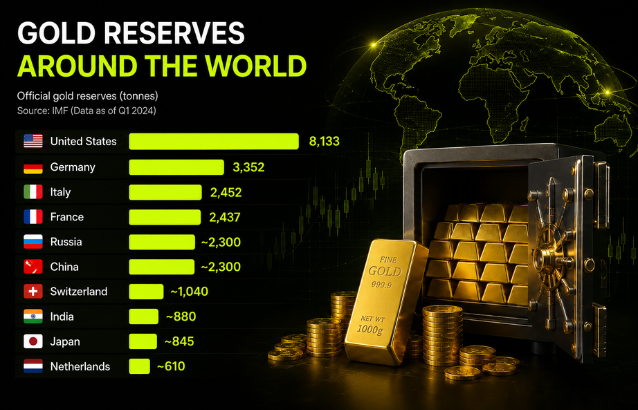
Gold remains an important financial asset for governments around the world. According to data from the International Monetary Fund (IMF) and central bank reports, the countries with the largest official gold reserves include:
Country
Official Gold Reserves
United States
8,133 tonnes
Germany
3,352 tonnes
Italy
2,452 tonnes
France
2,437 tonnes
Russia
Around 2,300 tonnes
China
Around 2,300 tonnes
Switzerland
Around 1,040 tonnes
India
Around 880 tonnes
Japan
Around 845 tonnes
Netherlands
Around 610 tonnes
The United States holds the world’s largest official gold reserves, with more than 8,000 tonnes stored mainly at facilities such as Fort Knox and other Federal Reserve locations.
Large gold reserves are not only a symbol of national wealth. Governments hold gold because it provides diversification, carries no counterparty risk, and can act as a financial safeguard during periods of currency instability or economic uncertainty.
In recent years, central banks, particularly in emerging markets, have increased gold purchases as they look to strengthen their reserves and reduce reliance on traditional currencies.
Why Is Gold Becoming More Valuable Today?
Gold has attracted significant attention in recent years as several global trends have increased demand.
Central bank purchases have been one of the strongest drivers of the gold market. Many governments have increased their gold holdings to diversify reserves and reduce dependence on major currencies.
At the same time, concerns about inflation, government debt, geopolitical risks, and economic uncertainty have encouraged investors to seek assets that can provide protection during volatile periods.
Expectations of lower interest rates have also supported gold prices. Since gold does not generate interest income, lower rates can reduce the opportunity cost of holding gold compared with assets such as bonds.
These factors have helped gold reach historically high price levels and reinforced its importance in modern investment portfolios.
What Factors Affect Gold Prices?
Understanding the factors that influence gold prices can help traders and investors better understand market movements.
Interest Rates
Interest rates have a major impact on gold demand. When rates are lower, investors may find gold more attractive because the return difference between gold and interest-bearing assets becomes smaller.
Higher interest rates can reduce demand as investors shift towards assets that provide income.
US Dollar Strength
Gold is priced in US dollars, meaning currency movements can influence its price. A weaker US dollar often makes gold cheaper for international buyers, potentially increasing demand.
A stronger dollar can make gold more expensive and put pressure on prices.
Geopolitical Events
Wars, financial crises, and global uncertainty often increase demand for gold as investors look for protection from market volatility.
Central Bank and ETF Demand
Central banks and gold-backed exchange-traded funds (ETFs) can significantly influence gold demand. Increased institutional buying can support prices, while reduced demand may create pressure on the market.
How Much Gold Exists in the World?
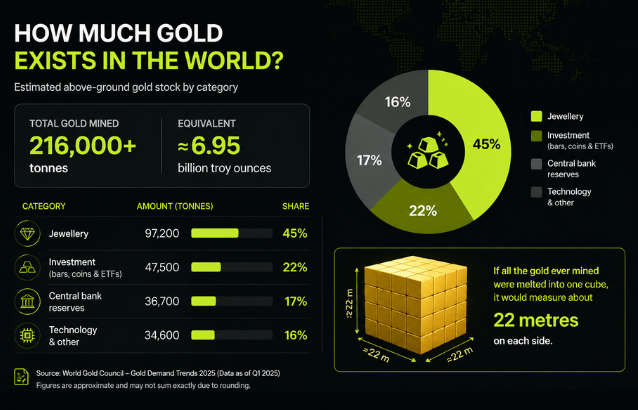
According to estimates from the World Gold Council, around 216,000 tonnes of gold have been mined throughout history.
Existing gold is mainly divided into:
Category
Approximate Share
Jewellery
Around 45%
Investment bars, coins and ETFs
Around 25%
Central bank reserves
Around 17%
Technology and industrial use
Around 13%
Because new gold production remains limited compared with existing demand, scarcity continues to be a key reason behind gold’s value.
Why Do Traders Buy Gold?
Gold is one of the most actively traded commodities because it combines liquidity with strong price movements.
Traders often monitor gold because it reacts quickly to:
Federal Reserve interest rate decisions
Inflation data
US Dollar movements
Employment reports
Geopolitical developments
Gold can be accessed through different financial instruments, including futures, ETFs, and CFDs. For short-term traders, gold provides opportunities around major economic events, while long-term investors often use it as a way to diversify their portfolios.
FAQs
Why is gold more valuable than other metals?
Gold is more valuable because it is rarer, highly durable, globally accepted, and has been trusted as a store of wealth for thousands of years.
Will gold always remain valuable?
Gold has maintained its value throughout history because of limited supply and strong global demand. However, gold prices can still fluctuate depending on economic conditions.
Why do central banks buy gold?
Central banks buy gold to diversify reserves, reduce currency risks, and strengthen financial stability during uncertain periods.
Share Now
Disclaimer:This content is provided for informational purposes only and does not constitute, and should not be construed as, financial, investment, or other professional advice. No statement or opinion contained herein should be considered a recommendation by Ultima Markets or the author regarding any specific investment product, strategy, or transaction. Readers are advised not to rely solely on this material when making investment decisions and should seek independent advice where appropriate.
Thank you for visiting the Ultima Markets website. Please note that this website is intended for individuals residing in jurisdictions where access is permitted by law. Ultima and its affiliated entities do not operate in your home jurisdiction.
By clicking ‘Acknowledge’, you confirm that you are entering this website solely on your own initiative and not as a result of any specific marketing outreach. You wish to obtain information from this website based on reverse solicitation principles, in accordance with the applicable laws of your home jurisdiction.