This website is managed by Ultima Markets’ international entities, and it’s important to emphasise that they are not subject to regulation by the FCA in the UK. Therefore, you must understand that you will not have the FCA’s protection when investing through this website – for example:
You will not be guaranteed Negative Balance Protection
You will not be protected by FCA’s leverage restrictions
You will not have the right to settle disputes via the Financial Ombudsman Service (FOS)
You will not be protected by Financial Services Compensation Scheme (FSCS)
Any monies deposited will not be afforded the protection required under the FCA Client Assets Sourcebook. The level of protection for your funds will be determined by the regulations of the relevant local regulator.
Note: UK clients are kindly invited to visit https://www.ultima-markets.co.uk/. Ultima Markets UK expects to begin onboarding UK clients in accordance with FCA regulatory requirements in 2026.
If you would like to proceed and visit this website, you acknowledge and confirm the following:
1.The website is owned by Ultima Markets’ international entities and not by Ultima Markets UK Ltd, which is regulated by the FCA.
2.Ultima Markets Limited, or any of the Ultima Markets international entities, are neither based in the UK nor licensed by the FCA.
3.You are accessing the website at your own initiative and have not been solicited by Ultima Markets Limited in any way.
4.Investing through this website does not grant you the protections provided by the FCA.
5.Should you choose to invest through this website or with any of the international Ultima Markets entities, you will be subject to the rules and regulations of the relevant international regulatory authorities, not the FCA.
Ultima Markets wants to make it clear that we are duly licensed and authorised to offer the services and financial derivative products listed on our website. Individuals accessing this website and registering a trading account do so entirely of their own volition and without prior solicitation.
By confirming your decision to proceed with entering the website, you hereby affirm that this decision was solely initiated by you, and no solicitation has been made by any Ultima Markets entity.
Ultima Markets does not have an establishment in Singapore and does not operate from Singapore.
Ultima Markets does not provide products or services to citizens or residents of Singapore, and account applications from Singapore citizens or residents will not be accepted.
If you are a citizen or resident of Singapore, please do not open an account or use Ultima Markets’ products or services.
By selecting “Acknowledge and Continue Browsing”, you confirm that you are accessing this website on your own initiative and that your access is not the result of any direct marketing, targeted advertising, solicitation, or promotional activity by Ultima Markets.
Nothing on this website constitutes an offer, solicitation, or promotion of products or services in any jurisdiction where such activity is prohibited. You are responsible for ensuring that your access to and use of this website complies with applicable local laws and regulations.
Learn calls vs puts, how call and put options work, their key risks, breakeven points and when traders may use each strategy in the market with examples.
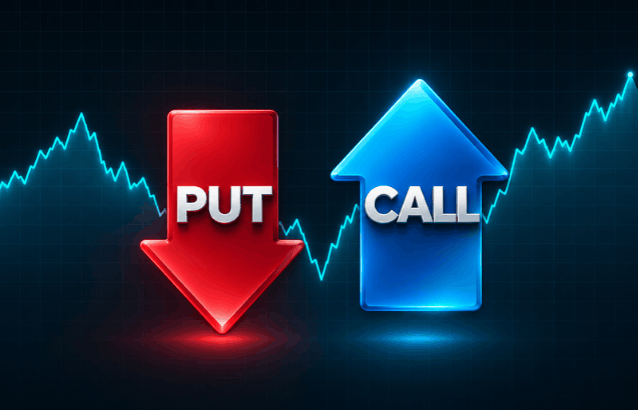
If you are learning about options trading, understanding calls vs puts is a good place to start. These two contracts allow traders to take different views on the market, but their potential returns depend on more than whether an asset’s price goes up or down.
A call is generally associated with a bullish outlook, while a put is often linked to a bearish view. Both, however, come with a cost and an expiration date.
This guide explains how calls and puts work, compares their risks, and walks through simple examples to help you understand the difference.
What Are Calls and Puts?
Calls and puts are the two main types of options contracts. Their value is linked to an underlying asset, such as a stock, exchange-traded fund or index.
A call option gives the buyer the right, but not the obligation, to buy the underlying asset at a specified price.
A put option gives the buyer the right, but not the obligation, to sell the underlying asset at a specified price.
The specified price is known as the strike price, and the cost of buying the option is called the premium. Each contract also has an expiration date.
In exchange for receiving the premium, the option seller takes on an obligation if assigned. The exact exercise and settlement terms depend on the contract.
Calls vs Puts: The Key Differences
Buyer’s right
Buy the underlying asset
Sell the underlying asset
Typical buyer’s outlook
Bullish: expects the price to rise
Bearish: expects the price to fall
In the money
Asset price is above the strike
Asset price is below the strike
Buyer’s maximum loss
Premium paid, plus costs
Premium paid, plus costs
Buyer’s potential profit
Theoretically unlimited for a stock call
Limited because a stock price cannot fall below zero
Common use
Speculate on a price increase
Speculate on a decline or protect shares
These descriptions apply to buying options. Selling calls or puts involves different risks and obligations.
Key Terms for Options Trading You Should Know
Before comparing call and put examples, it helps to understand a few basic terms.
Strike price: The price at which the buyer can buy or sell the underlying asset if the option is exercised.
Premium: The amount paid to purchase the option. A standard US equity option typically represents 100 shares, so a premium of $3 per share generally costs $300 per contract. Some contracts have different sizes.
Expiration date: The date when the option contract ends. Exercise rules vary: some options can be exercised before expiration, while others can only be exercised at expiration.
In the money: A call is in the money when the asset price is above the strike price. A put is in the money when the asset price is below the strike price.
An option can be in the money and still result in a loss if its value does not cover the premium paid and trading costs.
How Does a Call Option Work?
A trader typically buys a call option when they expect an asset’s price to rise.
The contract gives the buyer the right to purchase the asset at the strike price. If the market price rises above that level, the right to buy at the lower price can become valuable.
Call Option Example
Suppose a stock is trading at $100 per share. You buy one call option with a:
Strike price: $100
Premium: $5 per share
Contract size: 100 shares
Total premium: $500
If the stock closes at $115 at expiration, the call has an intrinsic value of $15 per share. After subtracting the $5 premium, the simplified profit is:
($115 − $100 − $5) × 100 = $1,000
If the stock closes at $103, the call is in the money by $3 per share. But because you paid a $5 premium, the position still has a $200 loss, excluding costs.
If the stock closes at or below $100, the option expires without intrinsic value and the buyer loses the $500 premium.
Call Option Breakeven
For a call bought and held until expiration:
Breakeven = Strike price + Premium
In this example, the breakeven is $105 per share, before fees. An option sold before expiration can have a different result because it may still have time value.
How Does a Put Option Work?
A trader typically buys a put option when they expect an asset’s price to fall.
The put gives the buyer the right to sell the asset at the strike price. If the market price falls below that level, the right to sell at the higher price can become valuable.
Investors may also buy puts to help protect shares they already own.
Put Option Example
Suppose the same stock is trading at $100. You buy one put option with a:
Strike price: $100
Premium: $4 per share
Contract size: 100 shares
Total premium: $400
If the stock closes at $85 at expiration, the put has an intrinsic value of $15 per share. After subtracting the premium, the simplified profit is:
($100 − $85 − $4) × 100 = $1,100
If the stock closes at $98, the put is in the money by $2 per share. However, after accounting for the $4 premium, the buyer has a $200 loss, excluding costs.
If the stock closes at or above $100, the put expires without intrinsic value and the buyer loses the $400 premium.
Put Option Breakeven
For a put bought and held until expiration:
Breakeven = Strike price − Premium
In this example, the breakeven is $96 per share, before fees.
Buying vs Selling Calls and Puts
Traders can either buy or sell a call or put. Buying provides a right, while selling creates an obligation if the seller is assigned.
Position
Typical outlook
Main risk
Buy a call
Bullish
The premium paid can be lost
Buy a put
Bearish or seeking protection
The premium paid can be lost
Sell a call
Often neutral to bearish
An uncovered stock call can have theoretically unlimited losses
Sell a put
Often neutral to bullish
Losses can be substantial if the stock falls sharply
For example, buying a put and selling a call can both reflect a bearish view, but their risks are different. A put buyer’s loss on the option is generally limited to the premium paid, while an uncovered call seller can face theoretically unlimited losses as the stock rises.
What Affects the Price of Calls and Puts?
Predicting whether the underlying asset will rise or fall is only one part of options trading. Other factors can affect the option’s premium.
1. The Underlying Asset’s Price
A rising stock price generally benefits a call buyer, while a falling stock price generally benefits a put buyer. However, the option’s value may not move by the same amount as the stock.
2. Time Until Expiration
Options have a limited life. As expiration approaches, their time value generally declines, a process known as time decay.
For buyers, this means the asset may move in the expected direction but not move far or fast enough to produce a profit.
3. Implied Volatility
Implied volatility reflects the market’s expectations for future price fluctuations. Higher implied volatility generally increases option premiums, all else being equal.
An option can therefore lose value even when the stock moves in the expected direction, especially if implied volatility falls after an event such as an earnings announcement.
4. Strike Price and Trading Costs
The strike price affects an option’s intrinsic value and how much the asset may need to move for the trade to profit.
Traders should also consider commissions and the bid-ask spread, which can increase the cost of entering or exiting a position.
When Might Traders Use Calls or Puts?
Buying Calls for a Bullish View
A trader expecting a stock to rise may buy a call for potential upside exposure without purchasing the shares upfront.
However, a correct bullish view does not guarantee a profit. The stock must move enough, within the relevant timeframe, to offset the premium and costs.
Buying Puts for a Bearish View
A trader expecting a stock to fall may buy a put. If the decline is large enough, the put may gain value.
The loss on a purchased put is generally limited to the premium paid and costs, but the buyer can still lose the entire premium.
Buying Puts to Protect Shares
An investor who owns shares may buy a protective put. If the stock falls, gains in the put may help offset some losses in the shares while the contract remains active.
This protection comes at a cost: the premium reduces the investor’s overall return. The protection also expires and depends on the contract’s strike price and size.
Common Mistakes to Avoid
When comparing calls vs puts, beginners should be aware of these common mistakes:
Ignoring the premium: An option can be in the money at expiration and still result in a loss.
Focusing only on direction: Time decay and volatility can affect the option’s value.
Confusing buying with selling: Option sellers can face obligations and losses far greater than the premium received.
Overlooking expiration: A price move after an option expires cannot benefit that expired contract.
Assuming all options are the same: Contract sizes, exercise rules and settlement methods can vary.
Conclusion
The main difference between calls vs puts is the right they give the buyer. A call gives the right to buy an underlying asset, while a put gives the right to sell it.
Calls are commonly used for a bullish view, while puts can express a bearish view or help protect an existing investment. In both cases, traders should consider the premium, strike price, expiration date and volatility before entering a position.
Options offer flexibility, but they can lose value quickly. Understanding the contract and its potential loss is an essential first step.
FAQs
What is the difference between a call and a put?
A call gives its buyer the right to buy the underlying asset at the strike price. A put gives its buyer the right to sell it.
Are calls or puts better for beginners?
Neither is automatically better. The choice depends on the trader’s outlook and objective. Both can expire worthless.
Do you buy calls or puts when a stock goes up?
A trader expecting a stock to rise may buy a call. However, the price must move sufficiently to overcome the premium and other factors for the trade to profit.
Share Now
Disclaimer:This content is provided for informational purposes only and does not constitute, and should not be construed as, financial, investment, or other professional advice. No statement or opinion contained herein should be considered a recommendation by Ultima Markets or the author regarding any specific investment product, strategy, or transaction. Readers are advised not to rely solely on this material when making investment decisions and should seek independent advice where appropriate.
Thank you for visiting the Ultima Markets website. Please note that this website is intended for individuals residing in jurisdictions where access is permitted by law. Ultima and its affiliated entities do not operate in your home jurisdiction.
By clicking ‘Acknowledge’, you confirm that you are entering this website solely on your own initiative and not as a result of any specific marketing outreach. You wish to obtain information from this website based on reverse solicitation principles, in accordance with the applicable laws of your home jurisdiction.